



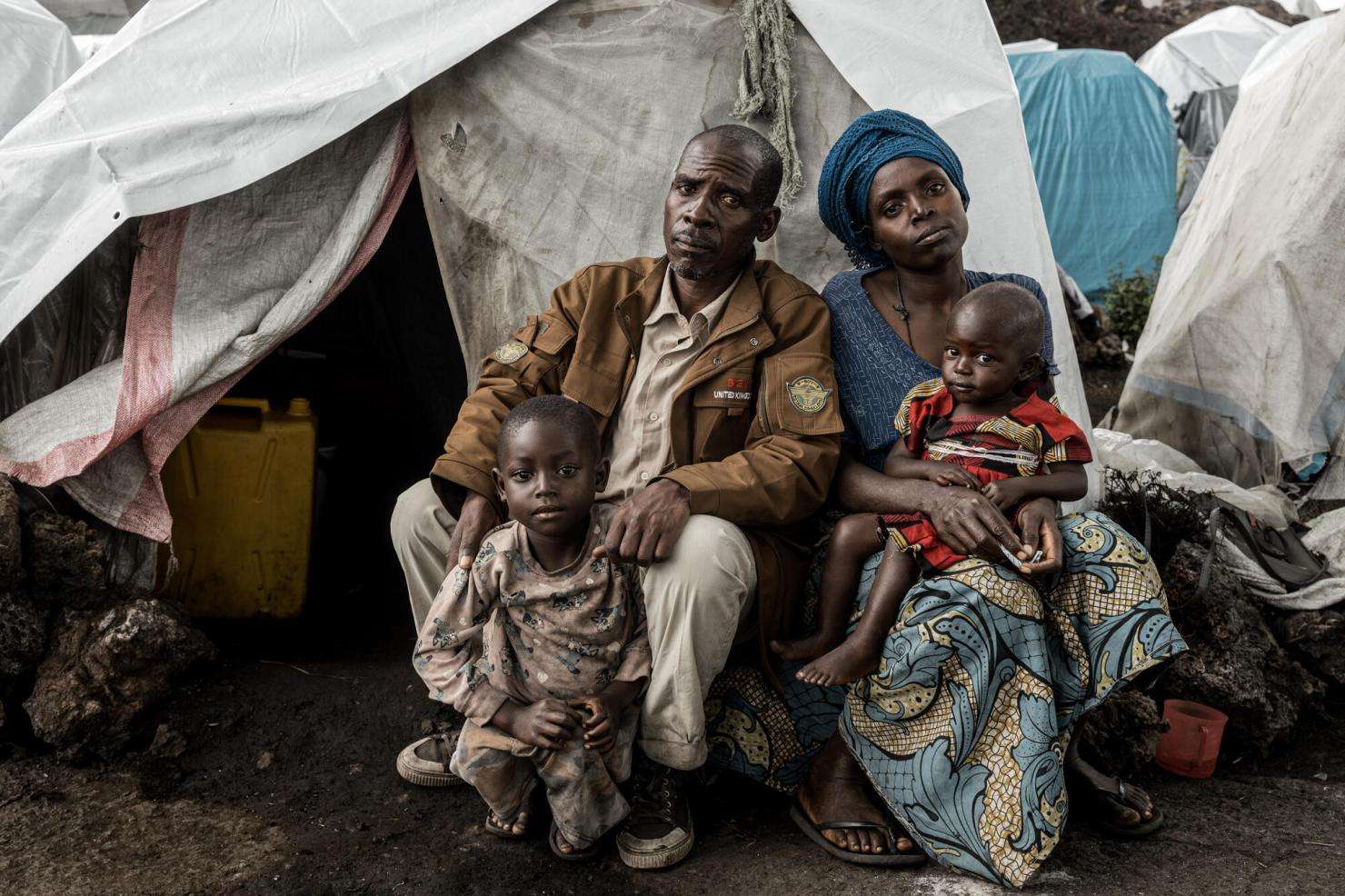
When diplomats discuss ceasefires and territorial control, when analysts track mineral flows and armed group movements, they describe one version of the crisis in eastern DRC. But there is another crisis unfolding quieter, more intimate, and far more devastating. It is the crisis of a 14-year-old girl recovering from surgery after multiple rapes. Of a mother choosing which of her malnourished children gets the day’s only meal. Of an elderly man abandoned when displacement camps closed, too frail to flee, left waiting for death in a church courtyard.
This is the humanitarian catastrophe that high-level political coverage obscures.
In just the last two weeks of February 2025, humanitarian workers recorded 895 reports of rape in eastern DRC, more than 60 per day. By March, that number had exploded. ActionAid teams documented a 700% increase in sexual violence reports between February and March 2025, with 381 cases reported in March and April alone.
These numbers are not anomalies. Médecins Sans Frontières treated nearly 40,000 survivors of sexual violence in North Kivu province in 2024, a record high. In the first four months of 2025, they treated 7,400 more patients in facilities around Goma, and over 2,400 in the small town of Saké alone.
But these statistics, as staggering as they are, represent only survivors who managed to reach care facilities. UNFPA Director Shoko Arakaki, after visiting eastern DRC, stated bluntly that the reported cases are “likely only a fraction of the actual survivors.”
When Survival Becomes Complicity
For women in eastern DRC, sexual violence is not confined to battlefields. It has become woven into the fabric of daily survival.
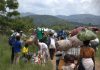
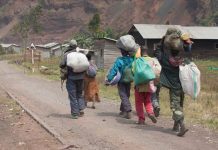
After M23 forces ordered the dismantling of displacement camps around Goma in February 2025, hundreds of thousands of people were forced to leave. Women who had been living in camps, inadequate as they were, suddenly found themselves sheltering in host families’ homes, community centers, churches, or makeshift structures in school courtyards.
François Calas, head of MSF’s program in North Kivu, described what his teams encounter: “We receive many women who have been abused in or near host families’ homes or community centers where they are staying. Very often, they are coerced into sexual acts in exchange for accommodation. Wherever they are, they don’t seem to be safe anywhere.”
This is the invisible violence of displacement. A woman fleeing armed conflict arrives at what should be safety, a family taking in displaced people, a community shelter, and finds herself facing a choice: submit to sexual coercion or become homeless with her children.
Nasha’s story captures this impossible reality. After fleeing Masisi territory and living in Rusayo displacement camp, she was forced out when the camps were dismantled. She built a shelter in a school courtyard. Armed men broke in one evening. They raped her. When her husband tried to protect her, they killed him in front of their eight children.
There is no safe space. Not in camps. Not in host communities. Not in fields where women search for firewood or work to grow food. Not on roads. Not in churches.
The Children Bearing Adult Burdens
Among the 895 rape cases reported in just two weeks in February 2025, more than 150 involved children.
A 14-year-old girl met by UNFPA staff was recovering from surgery after surviving multiple rapes. She told aid workers she still dreams of returning to school.
Those details of her dream of school illuminate what sexual violence steals from children in eastern DRC. Not just their bodies and safety, but their futures. Their education. Their childhood itself.
Nearly 500 cases of sexual violence were reported in a single week in the North Kivu area in early 2025. Many involved children. But the healthcare infrastructure to treat them has collapsed.
Between March and September 2025, North Kivu province experienced a near-total lack of post-exposure prophylaxis (PEP) kit emergency medical supplies that prevent HIV transmission and other infections after sexual assault. In May 2025, only 7 of 34 health zones had minimal supplies. By September, only 895 complete kits were available for the entire province, where hundreds of cases occur each week.
The Trump administration’s dismantling of USAID in early 2025 made this crisis catastrophic. An order for 100,000 post-rape kits that were to be distributed to organizations treating survivors in eastern DRC was cancelled. Women and girls who survive rape now face the additional sentence of potential HIV infection, sexually transmitted diseases, and pregnancy from assault all preventable with timely medical care that no longer exists.
For children who survive sexual violence, the consequences compound across their entire lives. Pregnancies from rape. STIs. Psychological trauma with no access to mental health services. Educational disruption, if they had access to school at all before the violence.
ActionAid documented 58 cases of forced or early marriage in just the first four months of 2025, already reaching 86% of the total recorded throughout all of 2024. These are girls whose childhoods are being erased, not just by sexual violence but by families desperate to reduce the number of mouths to feed, trading daughters for survival.
The Silent Starvation
While sexual violence dominates headlines when the crisis in eastern DRC gets international attention at all, hunger is killing children just as surely but more slowly, more quietly.
By January 2026, approximately 14 million children in DRC are expected to face crisis levels of hunger or worse. Among them, 2.1 million face emergency levels of hunger, the kind characterized by acute malnutrition and heightened risk of hunger-related death.
Seventy-five percent of these children live in the eastern provinces: Ituri, North Kivu, South Kivu, and Tanganyika.
The numbers reveal catastrophic escalation. The number of people facing emergency hunger in eastern DRC has almost doubled since 2024. Over 10 million people in the four eastern provinces face crisis levels of hunger or worse, one in three people.
For children, this translates into bodies that cannot grow, immune systems that cannot fight disease, and minds that cannot learn. Between July 2025 and June 2026, over 4.18 million children aged 6-59 months are suffering or expected to suffer from acute malnutrition. More than 1.35 million face severe acute malnutrition, the kind that kills.
In some areas, reports indicate over 60% of children are malnourished. Nationwide, nearly half of all children under 5, a total of 3.2 million, are stunted due to chronic malnutrition, with impaired growth and development that will affect them for life.
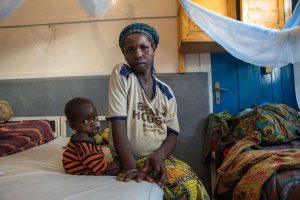
Claudine’s story, documented by the World Food Programme, embodies millions of others. The 41-year-old mother of seven once grew the food her family ate in Ituri Province. Today, displaced by fighting, she lives in a camp near the Ugandan border with her baby daughter, so malnourished that she required hospitalization.
“We have difficulties in eating,” Claudine said, a statement so simple it barely conveys the reality. Which child eats today? Which goes hungry? How do you explain to a 5-year-old why there’s no food when they’re crying from hunger?
When Farms Become Battlefields
The hunger crisis is not just about disrupted supply chains or closed markets, though those matter. It’s about subsistence farmers, the backbone of eastern DRC’s food production, being unable to access their fields because armed groups control the territory, or because fleeing violence means abandoning crops mid-season.
Millions of farmers displaced by conflict missed the 2025 planting season entirely. A farmer displaced in January cannot plant seeds. A farmer whose fields have been seized by armed groups or occupied by other displaced people cannot harvest. A woman too afraid to walk to her field because she might be raped on the road cannot grow food for her children.
The conflict doesn’t just destroy current food supplies. It destroys the capacity to produce food in the future.
And when families do have access to markets, prices have become prohibitive. A WFP market assessment found staple food prices skyrocketing in eastern DRC: maize flour increased by 67%, salt by 43%, oil by 45%. For families whose income has disappeared because they fled their homes and livelihoods, these price increases mean starvation.
The People Left Behind to Die
If women and children are marginalized in humanitarian responses, elderly people in eastern DRC are virtually invisible.
When M23 advanced, and displacement camps were forcibly closed in early 2025, families fled. But not everyone could run.
HelpAge DRC documented the crisis unfolding for older people: at least 6,780 elderly individuals stranded in public spaces around Goma after camps closed, with no transport, food, or aid. Some were left behind when families fled because they couldn’t move quickly enough or were too frail to make the journey. Others were forcibly returned to conflict zones by M23 or pressured by local authorities to leave, despite having nowhere safe to go.
Anatole Bandu, HelpAge DRC Country Representative, described scenes that should shock the world: “We see older people being forcibly sent back to conflict zones by the M23 armed group and pressure from local authorities, with no support, exposed to danger and deprivation. We hear heartbreaking stories every day of older people left behind when the makeshift camps close. They are struggling without food, medicine, or even a place to sleep.”
Across eastern DRC, approximately 350,000 displaced older people have been identified, many separated from families, unable to access healthcare for chronic conditions, and lacking the medications that keep them alive.
The Diseases Elderly Bodies Cannot Fight
For older people, displacement means death by a thousand deprivations. Cholera outbreaks—driven by contaminated water and poor sanitation in displacement sites are especially lethal for elderly people whose immune systems cannot fight infection.
By July 2025, nearly 33,000 cholera cases and over 700 deaths had been reported. For older people displaced to camps with inadequate latrines, contaminated water sources, and no access to medical care, cholera is often a death sentence.
Mpox outbreaks present similar dangers. DRC accounts for 96% of global mpox cases, with over 51,000 suspected cases and 1,224 deaths reported in 2024 alone. Older people, particularly those with underlying health conditions, face higher mortality rates.
But elderly people’s health needs extend far beyond epidemic diseases. Chronic conditions diabetes, hypertension, heart disease require ongoing medication and monitoring that displacement makes impossible. When an elderly person with diabetes flees their home, they leave behind their medication. Displacement camps rarely have supplies for chronic disease management.
HelpAge reports that access to vital medicines for older people is “almost non-existent” in displacement settings. This means elderly people with manageable chronic conditions are dying, not from violence, but from the absence of basic healthcare.
The Invisibility That Kills
Perhaps most damaging is that older people simply don’t register as priorities in humanitarian responses designed around women and children.
Anatole Bandu stated it plainly: “Older people are among the most vulnerable in this crisis, yet they are too often invisible to the world.”
When camps distribute food, the assumption is that able-bodied adults can queue for hours. Elderly people who cannot stand that long go hungry. When water points are far from shelters, younger people can make multiple trips. Older people cannot. When latrines are poorly designed or distant, elderly people with mobility issues may be unable to use them, leading to indignity and health complications.
The humanitarian system’s metrics of vulnerability often focus on women of reproductive age and children under 5 and systematically exclude elderly people from targeted assistance, even when they face comparable or greater risks.
What Political Coverage Misses
When international media covers eastern DRC’s crisis, the focus remains relentlessly political and military: which armed group controls what territory, what mineral resources are at stake, what diplomatic initiatives are underway.
This coverage isn’t wrong, but it’s profoundly incomplete.
It misses the 14-year-old who survived rape and still dreams of school, whose future has been stolen not by territorial control but by the absence of PEP kits.
It misses the mother of seven who once grew her own food and now watches her baby starve, displaced not by political machinations but by violence that makes farming impossible.
It misses the elderly man abandoned in a church courtyard when camps closed—invisible to both armed groups and humanitarian systems designed around different demographics.
The Questions That Matter
The experiences of marginalized groups reveal the questions that should drive crisis response but rarely do:
Not “Which armed group controls Rubaya?” but “Can the woman raped in Rubaya access emergency medical care?”
Not “What are mineral export figures?” but “How will the child whose mother was killed in fighting eat tomorrow?”
Not “What does the ceasefire agreement stipulate?” but “Will the elderly person left behind when camps closed receive food and medicine before they die?”
Not “How many troops are deployed?” but “Can the pregnant teenager displaced four times in two years deliver her baby safely?”
These questions don’t generate high-level diplomatic discussions or analytical reports about regional stability. But they determine whether millions of people live or die.
What Their Stories Demand From Us
The experiences of women, children, and elderly people in eastern DRC are not footnotes to a political crisis. They are the crisis.
Their stories demand recognition that:
Conflict cannot be understood only through territorial control and armed group movements. It must be understood through the lives it destroys, the girl who will never return to school, the baby dying from malnutrition, and the elderly person abandoned to die alone.
Peace cannot be measured only by ceasefire agreements and diplomatic frameworks. It must be measured by whether women can walk to their fields without fear of rape, whether children have food to eat, and whether elderly people receive the medicines that keep them alive.
Humanitarian response cannot remain chronically underfunded while military operations and mineral extraction continue unabated. The $18 million needed for reproductive health services, the $349 million for food assistance, these are not luxuries. They are lifesaving interventions being denied to millions.
International attention cannot focus exclusively on high-level politics while millions suffer invisibly. The 700% increase in sexual violence, the 2.1 million children facing emergency hunger, and the 6,780 elderly people stranded without support, these deserve headlines and political urgency.
KIVUPOST.COM is committed to centering the voices and experiences of those most affected by conflict in eastern DRC. We exist to document not just what armed groups do, but what ordinary people endure. We exist to demand that their suffering be acknowledged, their needs be prioritized, and their lives be valued.
This report is based on verified reporting from UN agencies, international humanitarian organizations, medical teams on the ground, and direct accounts from affected communities. Every statistic represents a person. Every person deserves to be seen.