



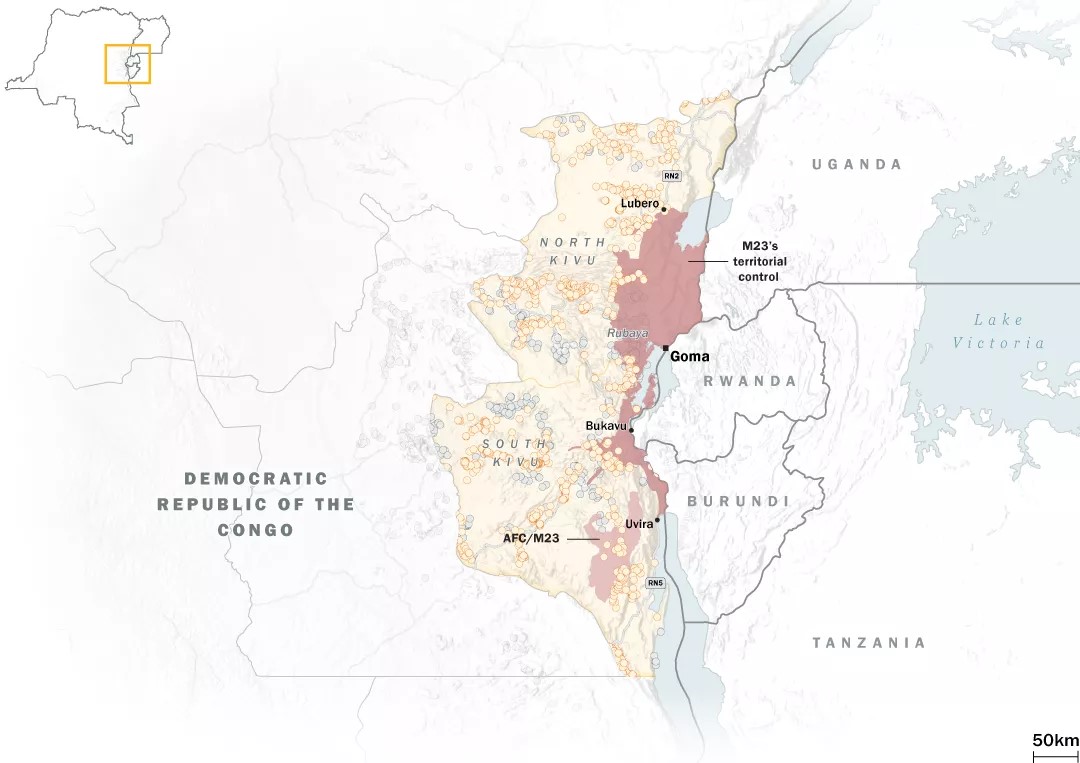
When armed groups control territory, they don’t just seize land; they seize economies. In AFC/M23 controlled areas of North and South Kivu, a parallel system of extraction, taxation, and cross-border trade has emerged that simultaneously enriches armed actors, impoverishes the Congolese state, and traps ordinary people between survival and complicity.
ALSO READ: M23 slams Kinshasa over Rubaya mine offer to US
Since AFC/M23’s resurgence in 2022 and its capture of key mining territories, culminating in the seizure of Goma and Bukavu in January 2025, the group has constructed what amounts to a functioning parallel state in eastern DRC. This is not simply a military occupation. It is economic governance.
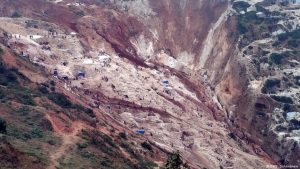
The clearest example is Rubaya, one of the world’s largest coltan deposits, which AFC/M23 captured in April 2024. Within weeks, the group established what it called a “ministry of mineral exploitation,” issuing mining permits bearing the label “République Démocratique du Congo, Province du Nord Kivu,” a deliberate performance of sovereignty.
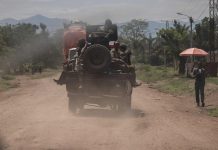
According to UN experts, AFC/M23 now controls every stage of the mineral value chain in Rubaya: extraction, trade, and transport. The group manages approximately 120 tonnes of coltan exports monthly, generating an estimated $800,000 per month from taxation alone. Convoys of four to five vehicles, each carrying up to five tonnes, make the journey to Rwanda twice weekly with clockwork regularity.
This is not chaotic looting. It is an organized extraction, complete with bureaucratic mechanisms that mirror and in some areas replace the Congolese state apparatus.
The recent capture of Lumbishi in South Kivu, a gold-rich area, and threats to Numbi (known for gold, tourmaline, and 3T minerals) signal AFC/M23’s expansion into even more lucrative mineral trade. Gold is significantly easier to monetize than coltan, making these new territories particularly valuable to the group’s financing operations.
While AFC/M23 claims independence, the economic evidence tells a different story. The group’s mineral empire functions because of and arguably for Rwanda’s economic integration.
The numbers are striking. Since the AFC/M23 resurgence in 2022, Rwanda’s official mineral exports have surged dramatically. Coltan exports doubled from approximately 1,000 tonnes to 2,000 tonnes between 2022 and 2023, with total mineral export revenue increasing by 43%. This growth precisely mirrors M23’s territorial expansion into mining areas.
The European Union acknowledged this reality in March 2025 by imposing sanctions on the Rwanda Mines, Petroleum and Gas Board (RMB) CEO Francis Kamanzi for illicit conflict-mineral exploitation, and on the Kigali-based Gasabo Gold Refinery for illegally importing gold from AFC/M23-controlled areas.
Even Rwandan President Paul Kagame has publicly admitted that Rwanda serves as a transit point for minerals smuggled from DRC, though he carefully framed it as uncontrolled private trade rather than state policy. The U.S. Treasury Department stated in 2022 that over 90% of the DRC’s gold is smuggled to regional states, including Rwanda and Uganda, where it is refined and exported to international markets, particularly the United Arab Emirates.
The mechanism is well-documented: minerals extracted from AFC/M23-controlled territories in the Eastern DRC are transported across the border, mixed with Rwanda’s limited domestic production (Rwanda has minimal mineral deposits of its own), laundered into “legitimate” supply chains, and re-exported as “Rwandan” origin. From there, they enter global markets through buyers in China, the UAE, Europe, and beyond.
Rwanda’s tax regime is significantly lower than DRC’s, creating a powerful economic incentive for this smuggling even without armed coercion. But when armed groups control the mining sites and transport routes, what might otherwise be tax-motivated cross-border trade becomes something else entirely: state-sponsored mineral laundering through military proxy.
While Rwanda’s role dominates international attention, Uganda operates its own mineral smuggling infrastructure that has persisted for decades.
According to UN reports and civil society investigations, Uganda exported $2.25 billion in gold between 2020 and 2021 despite having virtually no domestic gold production. The gold comes from eastern DRC, particularly from Ituri and parts of North Kivu, smuggled through networks that UN experts say are protected by Ugandan military forces operating in DRC.
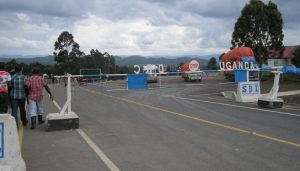
Uganda’s commercial relationship with eastern DRC has grown dramatically in recent years, with official trade statistics showing Uganda’s exports to DRC increasing from $432.4 million in 2016/17 to $981.5 million in 2024/25. Meanwhile, DRC’s exports to Uganda reportedly jumped from $23 billion in 2020 to $59.8 billion in 2024, figures that civil society analysts note include substantial quantities of illegally smuggled minerals falsely labeled as domestic Ugandan exports.
Kampala has long been a major trading location and transit hub for Congolese gold. The minerals move from artisanal mines controlled by various armed groups to smugglers who transport them to Uganda’s capital for sale onward, often to buyers in the UAE. This pattern was established during the Congo Wars of the 1990s, when Ugandan military forces directly controlled mining operations in eastern DRC, and it has continued in various forms ever since.
What makes this conflict economy particularly complex is that it coexists with genuine, legitimate cross-border trade that millions of ordinary people depend on for survival.
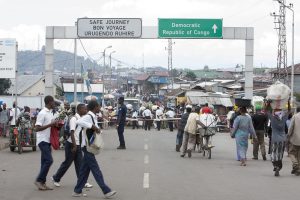
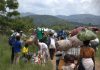
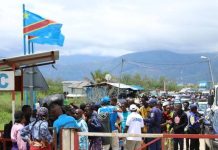
The border crossings between DRC and Rwanda, particularly between Goma and Rubavu, and between Bukavu and Rusizi, see tens of thousands of people crossing daily. At some points, as many as 40,000 people cross each day. Most are small-scale traders, predominantly women, moving agricultural products, livestock, textiles, and household goods back and forth.
This trade is vital. Studies show that cross-border trade provides income for the majority of these traders to pay school fees for their children (on average, 2.26 children per trader have their education funded this way). About 70% of cross-border traders in Rwanda’s western province, the main interface with DRC, are women, and for many, this trade represents their family’s primary income source.
Programs like TradeMark Africa’s Women in Trade Programme have supported nearly 35,000 women traders in Goma and Bukavu, helping them move from informal routes to formal trade channels. Incomes for participating traders increased by 46%, from an average of $275 to $510 per month, a transformative change for families living near or below the poverty line.
Uganda has also invested in cross-border trade infrastructure, building modern border markets and supporting road construction projects, including the Mpondwe/Kasindi-Beni (80km), Beni-Butembo (54km), and Bunagana-Rutshuru-Goma (89km) corridors. These roads are intended to reduce the cost of doing business and create economic opportunities.
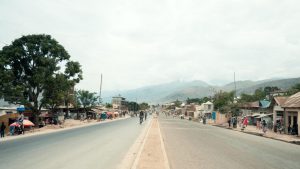
The problem is that this legitimate trade infrastructure, border posts, roads, and markets, now operates in territories controlled or contested by armed groups. The same roads that carry agricultural products to market also carry smuggled minerals. The same border crossings that formalize small traders’ businesses also facilitate the laundering of conflict resources.
While armed groups profit and neighboring countries benefit from transit trade, the Congolese state hemorrhages revenue.
DRC’s GDP decreased by 8.6% in 2023 and 6.5% in 2024, with further decline expected in 2025 due to instability in the mining areas that should be feeding state coffers. The parallel war economy denies the Congolese government revenues desperately needed to govern, build, and maintain infrastructure, and fund security services.
Consider the scale: if M23 alone extracts $800,000 monthly from Rubaya coltan, that’s nearly $10 million annually from a single mining area, revenue that should be funding schools, hospitals, roads, and governance in North Kivu. Multiply this across dozens of mining sites controlled by various armed groups, and the lost revenue reaches hundreds of millions of dollars annually.
This revenue loss creates a vicious cycle. Without mining revenues, the Congolese government cannot adequately fund its military, making it harder to reclaim territories controlled by armed groups. Without territorial control, it cannot tax economic activity, further reducing revenue. The state’s weakness perpetuates the conditions that allow armed groups to operate with impunity.
Meanwhile, populations in militia-controlled areas lack access to essential services, formal job markets, and legal businesses. This perpetuates cycles of poverty, reduces human capital development, and creates conditions where joining armed groups becomes an economically rational choice for young men with no alternative opportunities.
Eastern DRC’s future will be determined less by diplomatic negotiations and more by economic calculations.
Will it remain more profitable to extract minerals through armed groups and smuggling networks than through legitimate state channels? Will neighboring countries find it economically rational to maintain military presences and illicit trade corridors? Will global corporations face meaningful consequences for sourcing conflict minerals, or will cosmetic due diligence suffice?
For the people of North and South Kivu, these questions aren’t academic. They determine whether the small-scale trader can safely cross the border tomorrow. Whether the artisanal miner can feed his family without working for armed groups. Whether the shopkeeper’s business survives when conflict disrupts supply chains. Whether the young person has economic opportunities beyond joining a militia.
The minerals beneath the Kivus’ soil are neither curse nor blessing; they are simply minerals. What matters is who controls them, who profits from them, and who pays the cost of their extraction.
Right now, armed groups control, neighboring countries profit, and Congolese civilians pay.
Until that equation changes, no amount of diplomatic language about regional economic integration or peace frameworks will alter the fundamental reality: war is profitable, and peace is not.
KIVUPOST.COM is committed to investigating and exposing the economic dimensions of conflict in the Great Lakes Region. We exist to document not just who is fighting, but who is profiting and at whose expense. This analysis is based on UN reports, international investigations, civil society research, and on-the-ground reporting from eastern DRC.
We call on international actors, corporations, neighboring governments, and the Congolese state to acknowledge these economic realities and address them with the seriousness they demand. The people of the Kivus deserve economies that work for them, not against them.