





February 28, 2026, in a dramatic escalation that is reshaping the Middle East, the United States and Israel have launched coordinated military strikes against Iran today, opening what President Donald Trump described as “major combat operations” aimed at neutralizing what he called “imminent threats from the Iranian regime.” The assault, dubbed “Operation Epic Fury” by the U.S. Department of Defense and “Operation Lion’s Roar” by Israel, comes eight months after the two allies fought a 12-day war against Iran in June 2025 and strikingly, while diplomatic negotiations between Washington and Tehran were still nominally ongoing.
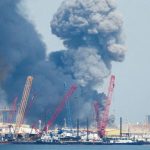
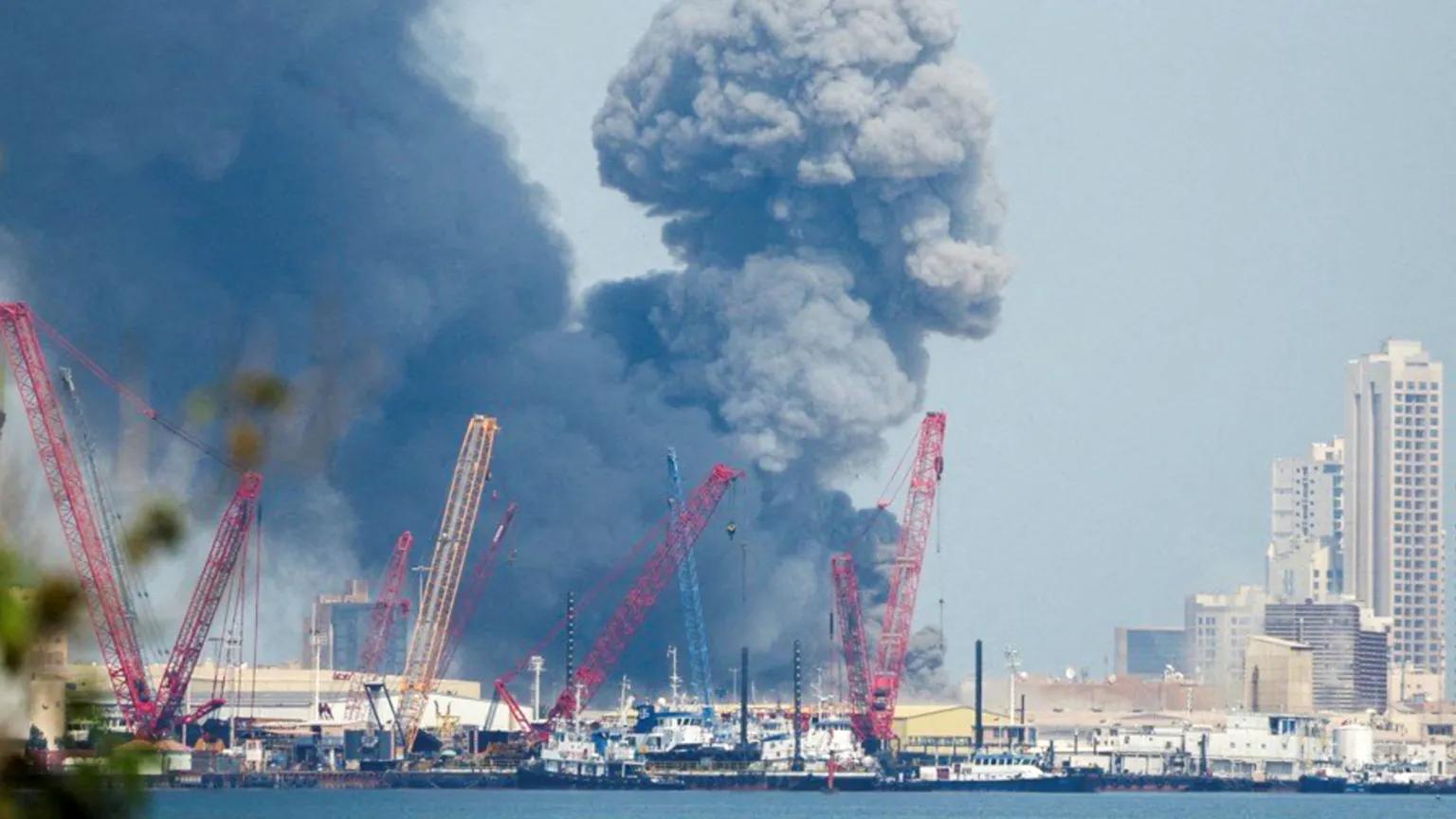
Explosions were heard and seen across Tehran and in other parts of Iran as the joint attack began on Saturday morning. Several missiles struck University Street and the Jomhouri area in Tehran, and smoke was seen rising from the city. In addition to the capital, the cities of Isfahan, Qom, Karaj, and Kermanshah were also targeted.
ALSO READ: Hundreds Flee as Heavy Fighting Intensifies in Masisi
Israel first announced that it had launched missile strikes on targets inside Iran, and a U.S. official confirmed the strikes were carried out as part of a joint military operation. In recent weeks, Washington had assembled a large fleet of fighter jets and warships in the region, its most significant military buildup there since the Iraq War. Trump described the operation as “massive and ongoing.”
Iran wasted little time in retaliating. Iran struck back with missiles and air strikes across the region, including at U.S. military bases in Bahrain, Qatar, Kuwait, and the United Arab Emirates. Iran’s Fars News Agency confirmed that Al Udeid Air Base in Qatar and the headquarters of the U.S. Navy’s 5th Fleet in Bahrain were among the targets. Qatar’s Defence Ministry said it had successfully thwarted several attacks, while the UAE reported one person killed after Iranian missiles were intercepted over Abu Dhabi.
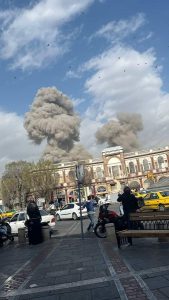
A senior Iranian official declared that “all American and Israeli assets and interests in the Middle East have become a legitimate target” and that “there are no red lines after this aggression.”
Today’s strikes did not emerge in a vacuum. They are the latest and most dangerous chapter in a long-standing confrontation rooted in Iran’s nuclear program, its regional proxy network, and deep mutual distrust.
Israel launched its first major direct attack on Iran on June 13, 2025, with 200 fighter jets striking more than a hundred targets. The opening salvo killed top Iranian military leaders, most notably Hossein Salami, the head of the Islamic Revolutionary Guard Corps; Mohammed Bagheri, chief of staff of the armed forces; and Amir Ali Hajizadeh, the IRGC’s air force commander, as well as several nuclear scientists.
The United States joined the military campaign on June 22, striking Iranian nuclear facilities at Natanz, Fordow, and Isfahan, with Trump claiming the attacks had degraded Tehran’s nuclear program. For the first time, the U.S. deployed the largest conventional bomb in its arsenal, the Massive Ordnance Penetrator, against the deeply buried Fordow enrichment facility. A ceasefire took hold on June 24, 2025, after 12 days of fighting, but it proved fragile.
Early intelligence assessments and the head of the International Atomic Energy Agency (IAEA) suggested that Iran’s nuclear program was set back by only a matter of months. Iran’s nuclear knowledge, its stockpile of enriched uranium, its centrifuge manufacturing capacity, and its determination to continue the program all remained intact.
In the months that followed, Trump pursued a renewed maximum pressure campaign while also engaging in indirect nuclear negotiations with Tehran. But those talks repeatedly broke down. Top U.S. officials publicly demanded that Iran end uranium enrichment, curb its ballistic missile program, and sever support for its proxy network. Meanwhile, Tehran sought to limit negotiations to its nuclear program in exchange for sanctions relief.
According to an Israeli defense official quoted by Reuters, today’s attacks had been planned for months, and the launch date decided weeks ago, even as the U.S. and Iran were carrying out negotiations. One analyst described the timing as an effort to “derail the negotiations” entirely.
The timing of the strikes raises serious questions. Iran’s Foreign Minister of Oman said that active negotiations mediated by his country between Iran and the U.S. were “yet again undermined” by the escalation, urging the U.S. “not to get sucked in further.”
Critics argue the attacks were designed to sabotage diplomacy as much as to damage Iran’s nuclear capabilities. Israeli Prime Minister Benjamin Netanyahu is said to have convinced Trump that U.S. participation was key to knocking out Iran’s most heavily fortified nuclear sites and coercing Tehran to give up its nuclear program altogether.
Netanyahu, for his part, thanked Trump for “his historic leadership,” arguing that Iran’s government had “spilled our blood, murdered many Americans, and massacred its own people,” and that “this murderous terrorist regime must not be allowed to arm itself with nuclear weapons.”
Russia sharply condemned the strikes, calling them “particularly reprehensible” for being carried out under the cover of the renewed negotiation process.
The strikes have immediately destabilized the broader Middle East. Multiple countries closed their airspace. U.S. embassies across the Gulf issued emergency alerts. Iran has signaled that regime survival is now the paramount concern.
Trump’s rhetoric has suggested he may be setting the table for regime change in Iran. Al Jazeera analysts noted the echoes of history: “It’s clear that this is going to be a continuous military operation, with Donald Trump accepting the fact that there may be casualties.”
Oil prices surged on the news, rattling global markets. The Strait of Hormuz, through which roughly 20% of the world’s oil supply passes, is now in the shadow of an active war.
The immediate question is whether this escalation leads to a wider regional war or a forced diplomatic resolution. Iran has vowed a “crushing” retaliation and shows no sign of surrendering its nuclear ambitions. The United States and Israel, meanwhile, appear committed to a sustained campaign.
Arms control experts warn that the strikes have severely reduced Iran’s incentives to allow the return of IAEA inspection teams, which are essential to monitor its nuclear activities. In the long run, they argue, illegal attacks on Iran by nuclear-armed states increase the likelihood that Iran may withdraw from the Nuclear Nonproliferation Treaty and pursue a clandestine weaponization campaign.
What is clear is that the Middle East has entered its most dangerous moment in years — and the world is watching to see whether the guns will eventually give way to the negotiating table, or whether today’s strikes are just the opening act of something far larger.
This article is based on breaking news as of February 28, 2026. Casualty figures and military assessments are still developing.